

UndiMsia! guide for first-time voters: How election works in Malaysia
Panduan ini juga tersedia dalam bahasa Melayu
该指南还有中文版
If you have never voted before, this guide walks you through the whole election process.
Elections in Malaysia do not run on a fixed calendar. The term for parliament and state legislative assemblies can run for a maximum of five years but an election can happen earlier. When it does, you will probably already be a voter. A 2019 constitutional amendment lowered the voting age from 21 to 18 and introduced automatic voter registration, so you no longer even have to sign up. If you are a citizen and you are 18 or older, you are (or soon will be) on the electoral roll.
Am I already registered as a voter?
Under article 119 of the Federal Constitution, every Malaysian citizen aged 18 and above is eligible to vote. Since December 2021, registration has been automatic and the Election Commission (Suruhanjaya Pilihan Raya, SPR) calls this PPSA (pendaftaran pemilih secara automatik). Under the Elections (Registration of Electors) Regulations 2002, SPR receives your citizenship status and residential address directly from the National Registration Department (Jabatan Pendaftaran Negara, JPN). There is no form to fill in.
According to PPSA FAQ, it can take around 1.5 months from your 18th birthday before your name is fully activated on the electoral roll. The process generally runs like this:
- You turn 18. You now meet the age qualification in article 119(1)(a) of the Federal Constitution.
- The monthly batch. SPR updates its records monthly. Everyone who turned 18 in, say, August is grouped into that month’s supplementary electoral roll (daftar pemilih tambahan, DPT) in early September.
- Certification. Then, SPR certifies and gazettes the DPT.
Therefore, if you turn 18 shortly before an election is called, there’s a possibility that you may not be a registered voter in time for that particular poll. Check your status on the MySPR Semak website with your MyKad number to be sure. If you are residing overseas, you may be eligible to apply to vote by post.
Your constituency is assigned based on the address on your MyKad, per article 119(1)(c) of the Federal Constitution and regulation 12 on registration of electors. If you have moved, update your address with JPN first. Only then you can apply through Form A for SPR to reassign your constituency. If not, you will be voting whichever area your MyKad says you live.
For what exactly am I voting?
Malaysians elect two levels of government. At the federal level, you choose a member of parliament (MP) who sits in the Dewan Rakyat and can determine who becomes prime minister. An MP can later be appointed to be a cabinet minister. At the state level, you choose a state assemblyperson (ahli dewan undangan negeri, ADUN) who sits in a state legislative assembly (dewan undangan negeri, DUN) and can determine who becomes menteri besar or chief minister. Some elected ADUNs will later become a member of the executive council (EXCO) of the state government. MPs and ADUNs are responsible for enacting laws as well as debating government policies at their respective levels.
Each level has its own election. A general election (pilihan raya umum, PRU) for parliament, a state election (pilihan raya negeri, PRN) for DUN, and a by-election (pilihan raya kecil, PRK) to fill a single vacant seat. In some states, PRN can happen at the same time as PRU in which case you will cast two ballots at once, one for each level. Because DUN can dissolve on its own timetable, in some states, PRN runs separately from PRU.
There’s one caveat if you are registered as a voter in a Federal Territory. Voters in Kuala Lumpur, Putrajaya, and Labuan will only vote for a parliamentary seat because they do not have DUN.
One thing you will not get for now is the third ballot, for your local council. Until 1965, Malaysians also elected their local governments, but local elections were suspended during the emergency period due to the Indonesia-Malaysia Confrontation and effectively abolished by the Local Government Act 1976.
Which localities vote for which seat is decided by SPR through a process called redelineation under article 113(2) of the Federal Constitution. SPR may begin reviewing the electoral map at intervals of not less than eight years. The most recent redelineation was completed in March 2018.
How does an election actually start?
An election must be held within 60 days from the dissolution of parliament or DUN (or a seat falls vacant, triggering a by-election or PRK). To formally start the process, SPR issues a writ of election to a returning officer (RO) under the Elections Act 1958. The RO is the official who runs the election operations locally, from nominations to declaring the winner. An RO is appointed for each constituency in each election.
SPR then announces three key dates, ie nomination day, the campaign period, and polling day, which typically falls on a Saturday or Sunday outside work days. This, however, has not always been the case in Malaysia’s electoral history.
The campaign period runs from the moment the RO announces the list of candidates on nomination day until 11.59pm on the eve of polling day, as defined in section 2 of the Election Offences Act 1954. The law sets a minimum of 11 days of campaigning, and in practice the election campaign period is around 2 weeks, eg 14 days during GE15 in 2022, and 11 days during GE14 in 2018.
Within the campaign period, make the effort to read manifestos in detail, follow credible news coverage, and attend an election rally or two. When election campaigners knock on your door, ask them what they actually plan for you and your community. This is the time for you to get to know the candidates for your constituency and learn more about their political platforms. Use this opportunity to engage people around you on how voting for elected representatives will affect issues that matter to you.
When and where do I vote? What do I need to bring?
Where and when? Your polling centre, polling stream (saluran mengundi), and suggested polling time are all available on MySPR Semak before polling day. Polling stations typically operate from 8am to 6pm in West Malaysia, and 7.30am to 5.30pm in East Malaysia. However, you should check the polling time for your area because SPR has the authority under the Elections (Conduct of Elections) Regulations 1981 to gazette shorter hours. Early closures are common in rural, remote, and island areas, where ballot boxes must be moved before nightfall.
Under regulation 23 on the conduct of elections, if you are already queueing inside the polling centre before closing time, you must be allowed to vote. The entrance cannot be locked if a voter arrived on time.
What to bring? Your MyKad. If you have lost it, SPR accepts these alternatives: a temporary identity document from JPN (Form JPN.KP09 or KP11, issued when you report a lost MyKad), a valid Malaysian passport (including a restricted passport), a Malaysian driving licence, or any official government identity card (such as a military or police identification card). Check the expiry date if using a passport or driving licence. Whichever document in use must be a physical original one as SPR will not accept a photocopy or any form of digital identification (such as MyDigital ID, MyJPJ, MyBorderPass, MyNIISe, etc).
There is no election dress code and you cannot be turned away for wearing shorts, skirts, or flip-flops. The only prohibition is clothing featuring names, symbols, logos of any political party or candidate, or other political paraphernalia.
What else to bring? The queue at your polling stream can be long and exposed to the weather, so bring an umbrella and a bottle of water. There is no ban on bags or everyday items. Make sure you are not wearing, holding, or carrying anything printed with the name, emblem, or symbol of any candidate or party within 50 m of a polling station as it is an offence under section 26(1) of the Election Offences Act 1954. You can bring your mobile phone with you but it cannot be used inside the polling station. You may be asked to temporarily leave it at a designated spot at the discretion of SPR officials and collect your mobile phone before you leave the polling station.
If possible, use public transportation or carpool with other voters to go to your polling centre. This will help ease traffic congestion during peak polling hours.

What happens inside the polling station?
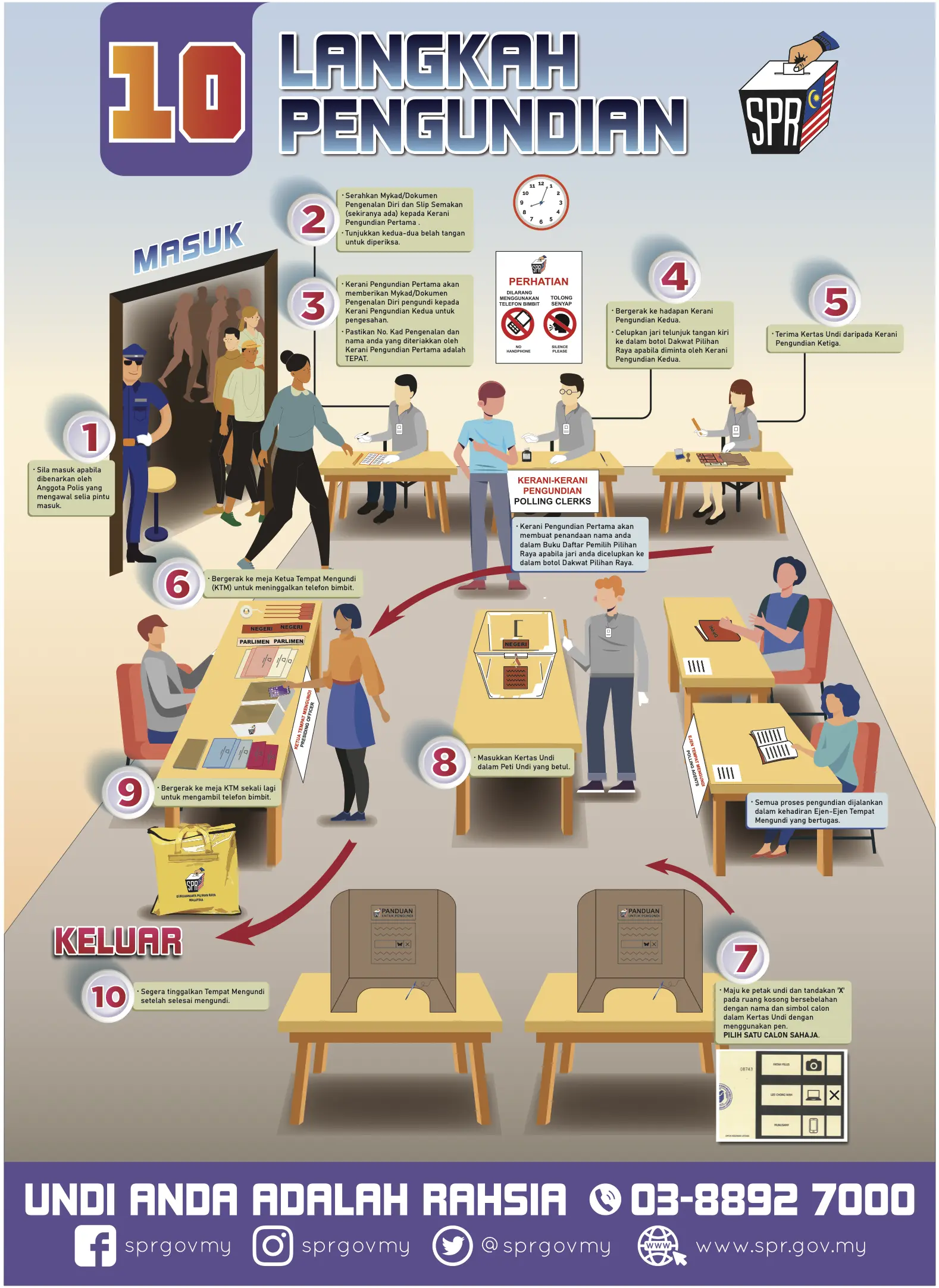
Go to your polling centre as early as possible because the queue for your stream can be long. At the polling station,
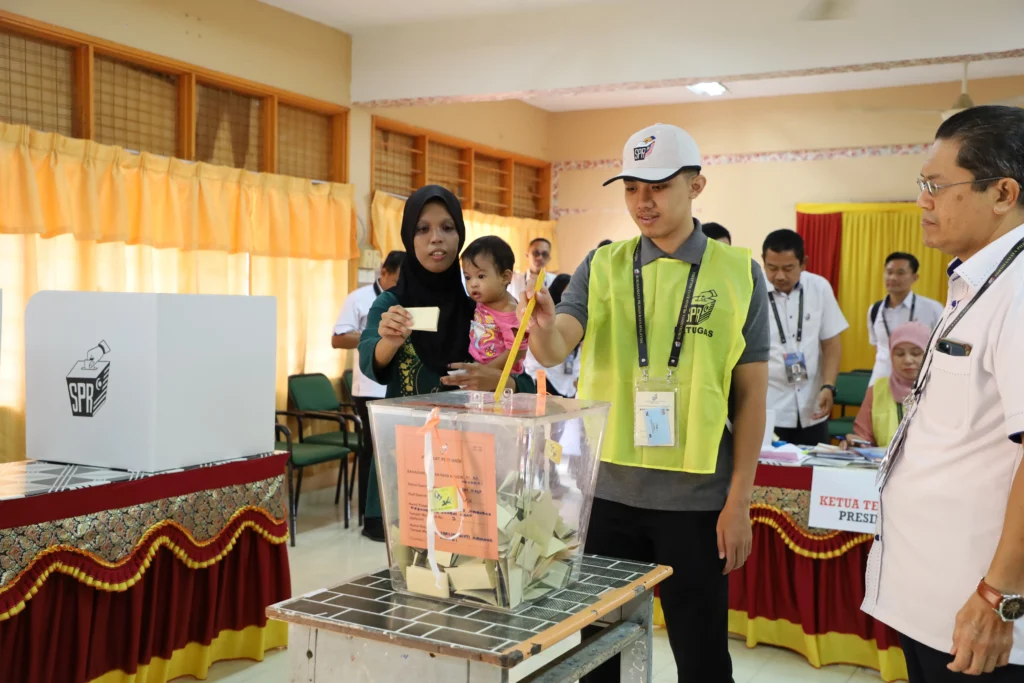
- Verification. Hand your MyKad or personal identification document to the polling clerk who confirms your details. After checking that your fingers are not marked with the indelible ink and your name has not been crossed out in the electoral roll, the polling clerk reads your name and your identity card number aloud. This allows the polling agent to cross check your details in their copy of the electoral roll.
- The indelible ink (dakwat kekal). A polling clerk will assist you to correctly dip the tip of a finger or thumb (preferably non-dominant index finger) into a bottle of indelible ink indicating that you have completed the process of casting the vote. If you have no digits, the indelible ink can also be applied to any part of your hand. The indelible ink will last for a few days and fade on its own after the election period.
- The ballot papers. Another polling clerk hands you – depending on whether you are voting for parliament, DUN, or both – one or two folded ballot papers containing the name and symbol of the candidates contesting in your constituency. Inspect the ballot papers: no tears, stains, or stray markings, and each should carry the official SPR stamp.
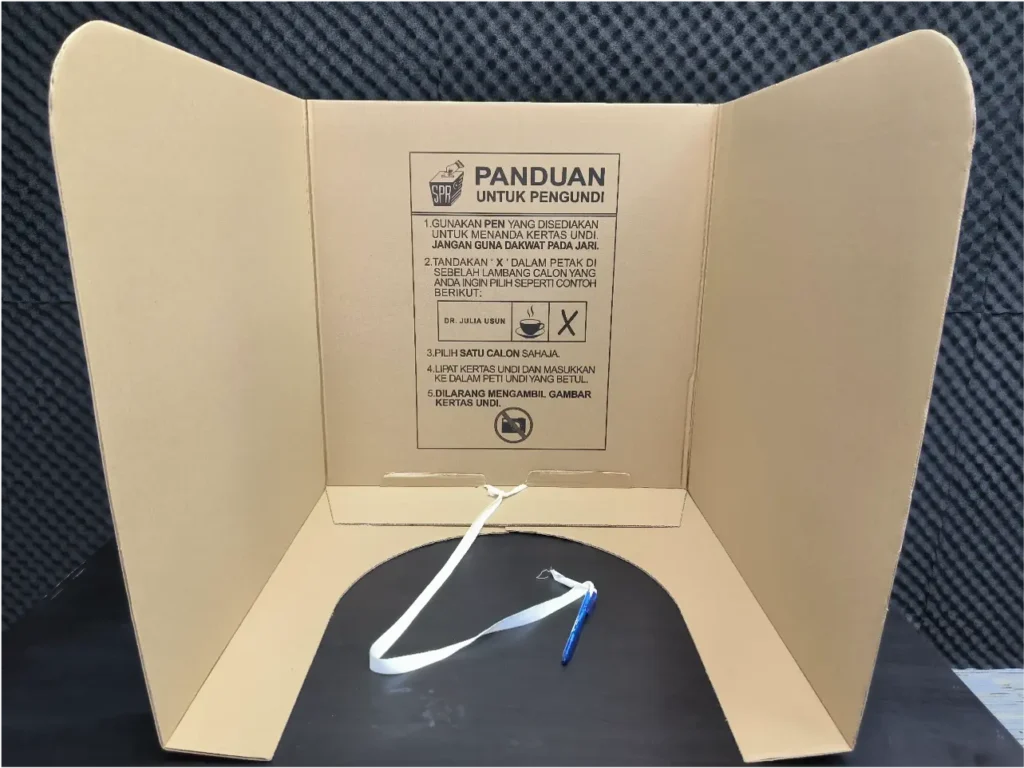
- Mark X. Move to the polling booth and unfold your ballot papers. Mark a single “X” in the box next to your chosen candidate using the pen provided. Multiple marks, drawings outside the lines, or written words will get your ballot paper counted as a spoilt vote (undi rosak).
- Secrecy. Do not photograph your ballot papers. Do not use your phone in the polling booth. Do not show your marked ballot paper. Breaching ballot secrecy is an offence under section 5 of the Election Offences Act 1954, punishable by up to a year in prison, a fine of up to RM3,000, or both.
- The right ballot box. Fold your ballot papers and drop each into the correct ballot box – the parliamentary ballot into the box labelled “parlimen”, the DUN ballot into the box labelled “negeri” – then leave the polling station. Don’t forget your identification document and personal items.
What if I am a person with disability or need assistance to cast my vote?
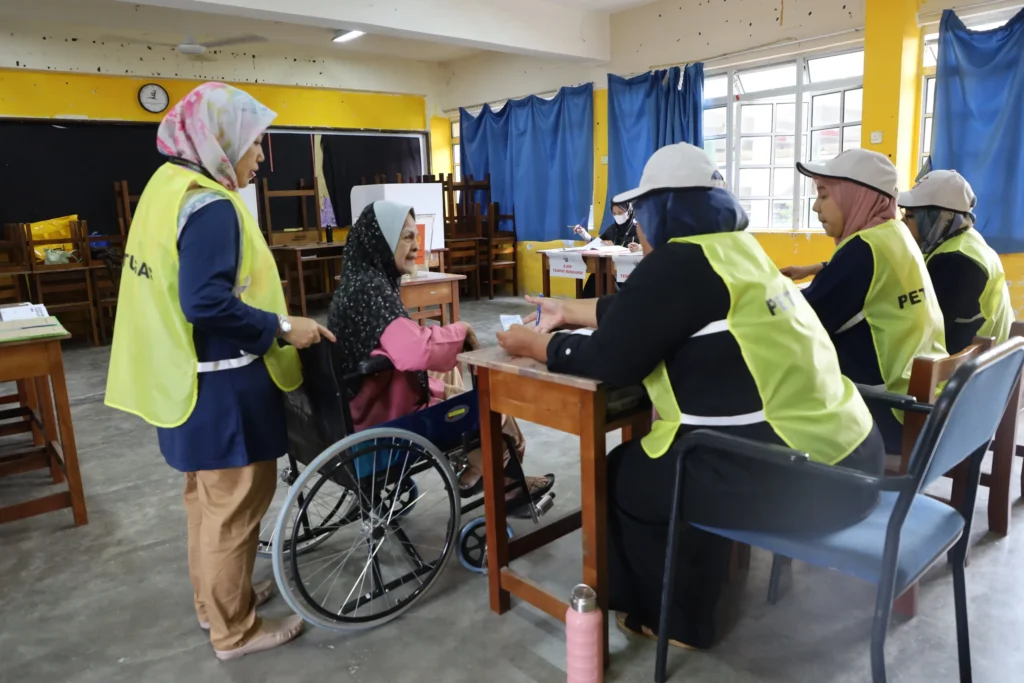
The polling streams are organised so that Stream 1 is closer to the polling centre entrance on the ground floor, generally for senior citizens but people with disabilities (orang kurang upaya, or OKU) are entitled to Stream 1 access regardless of the polling stream allocated by SPR. A wheelchair user assigned to an upper floor stream can request to vote on the ground floor instead (using Form SPR.765). In recent elections, SPR has also introduced dedicated channels and facilities for disabled voters.
If you cannot mark the ballot yourself, you have two options:
- You can complete a declaration form before the presiding officer (ketua tempat mengundi, or KTM) and bring a trusted Malaysian citizen aged 18 or above into the booth to mark it on your instructions; or
- If you have no helper, the KTM will read out the candidates’ names, take your choice confidentially, and mark the ballot on your behalf.
Advocacy groups such as BolehSpace and OKU Sentral have raised accessibility issues such as polling centres in older schools with steep stairs and no ramps, ballot papers not available in Braille, campaign material without sign language interpretation, and the absence of a unified SPR database of voters with disability. Assigning people with disability to Stream 1, they argue, is a workaround, not accessibility.
Does my employer have to let me go and vote?
Under section 25 of the Election Offences Act 1954, every employer must allow every voter in their employment a reasonable period to vote on polling day. Your employer cannot dock your salary for the time spent voting, force you to use your annual leave for it, intimidate or interfere with you over your right to vote – doing any of that is a criminal offence.
What counts as “a reasonable period” is not fixed because it depends on distance. If your polling centre is nearby, a few hours off or a shift adjustment is generally enough. For those who are voting outstation, employers are advised to grant flexible time or a full day off. Either way, if you live outside your constituency, plan to travel early and apply for time off work in good time.
I saw something wrong during an election. To whom do I report it?
Depending on what you witness, there are three different channels for election complaints.
The Royal Malaysian Police (Polis Diraja Malaysia, PDRM) handle criminal conduct under the Election Offences Act 1954, eg destruction of campaign materials, physical intimidation, or hate speech. Lodge a report at the nearest police station, with whatever physical or digital evidence you have.
The Malaysian Anti-Corruption Commission (MACC) handles vote buying cases – cash, food hampers, vouchers, or promises of public funds in exchange for votes – under the MACC Act 2009 and section 10 of the Election Offences Act. During election periods the MACC runs 24-hour election operation rooms in every state. You can also report through its complaints site, by email to [email protected], or on its hotline at 1-800-88-6000.
SPR’s enforcement teams, established under the Election Offences Act 1954, handle campaign rule breaches, eg campaigning after the deadline, campaigning within 50 metres of a polling station on voting day, or unauthorised loudspeakers. Complaints go to the district election enforcement team operating under the RO, or to SPR headquarters hotline at 03-8892 7000.
How are the votes counted? How is the integrity of the vote counting process guaranteed?
Vote counting starts after polls close. Early votes and postal votes (ie ballots from military and police personnel, election officials, overseas Malaysians, journalists, etc) are usually counted first.
Each candidate may appoint him/herself or someone else as an election agent. An election agent may appoint polling agents, counting agents, and barung agents – collectively known as PACABA. A polling agent checks the electoral roll when the polling clerk verifies the voter’s details and reports irregularities during the process of casting the vote. A counting agent observes every ballot being counted and ensures the integrity of the vote counting process. The barung agent observes and ensures the smooth running of the election process from outside the polling centre.
During the vote counting process, if a ballot is ambiguous – eg a tick instead of an X, or a mark straddling the line between candidates – a counting agent can object on the spot to the KTM who decides. A rejected ballot is stamped “ragu” (doubtful) or “ditolak” (rejected). If the objection is overruled, the ballot is stamped “bantah tapi diterima” (objected to but accepted) and given a serial number, creating a paper trail.
When vote counting in a stream finishes, the totals are entered into Form 14 (the statement of the poll) which the counting agents sign, keeping a carbon copy. That copy is the integrity mechanism. The numbers in the statement of the poll cannot vary between the polling station and the tallying centre.
There is also a right to recount. Under regulation 25 on the conduct of elections, if the margin between the top two candidates is 4% or less of the total valid votes cast in that stream (saluran), a counting agent can demand a one-time recount (kiraan semula) of that stream.
When and how do I know who won?
The signed Form 14 travels from each stream to the presiding officer, then on to the constituency’s official tallying centre (pusat penjumlahan rasmi undi). The RO is the only person legally authorised to finalise the count combining the totals of each stream with early and postal votes, cross checks the figures, and then announces each candidate’s total and declares the winner.
You will see “unofficial results” on television and social media before the RO’s announcement. That is because journalists reporting from the field relay Form 14 numbers to their newsrooms and they project winners based on that data. The official, legally binding results are the ones SPR publishes through its own channels. Usually, the SPR chairperson will announce overall tallies and election statistics in a live broadcast (eg GE15 announcement from 2022) and the full seat-by-seat detail published online.
Can an election result be challenged?
After polling day, a formal election petition can be filed in the High Court sitting as an Election Court. Under sections 32 and 34 of the Election Offences Act 1954, a candidate, a voter in that constituency, or a person claiming a right to have been nominated or elected can petition on grounds including non-compliance with election law that affected the outcome, corrupt practices such as bribery or intimidation, or the winner’s disqualification.
An election petition must be made within 21 days from the date the result is gazetted and meet all the legal requirements. Only an election judge can void a result, order a constituency-wide recount, or declare a different candidate duly elected.
Glossary
DPT daftar pemilih tambahan, the supplementary electoral roll
DUN Dewan Undangan Negeri, State Legislative Assembly (SLA)
Form 14 the statement of the poll for each s
JPN Jabatan Pendaftaran Negara, the National Registration Department
KTM ketua tempat mengundi, presiding officer
PACABA polling station agents, counting agents, and barung agents representing election candidates
PPSA pendaftaran pemilih secara automatik, automatic voter registration
PRK pilihan raya kecil, by-election
PRN pilihan raya negeri, state election
PRU pilihan raya umum, general election
RO returning officer, the official who runs the election in each constituency
Saluran mengundi, polling stream where voters take turns to complete the process of casting the vote
SPR Suruhanjaya Pilihan Raya, the Election Commission (EC)
Bulletin
Subscribe to our email newsletter to receive the latest news and updates from the MCCHR team directly in your inbox.
for Constitutionalism
and Human Rights