

A snapshot of human rights situation in Malaysia 2026
Maklumat ini juga tersedia dalam bahasa Melayu
General background
- 13-state federation with parliamentary democracy and constitutional monarchy.
- Population of 34.4 million in 2026 (34.2 million in 2025) – 47.5% of which female, 11% non-citizens – with a median age of 31.3 years in 2025 (30.9 years in 2024).
- Upper-middle-income economy with per-capita gross national income annual growth of 6.4% and higher than average income inequality (Gini index of 39).
- Suhakam (the Human Rights Commission of Malaysia) is the national human rights institution.
International obligations and commitments
Under international human rights law, states have the obligations and duties to respect, protect, and fulfil human rights.
Of the nine core international human rights instruments, Malaysia is party to only three – CEDAW, CRC, and CRPD. Malaysia ties with Brunei having the fewest ratifications in Southeast Asia lagging behind all other countries in the region.
International Convention on the Elimination of All Forms of Racial Discrimination
International Covenant on Civil and Political Rights
International Covenant on Economic, Social and Cultural Rights
Convention on the Elimination of All Forms of Discrimination against Women
2 reservations
Malaysia acceded to CEDAW in July 1995. However, it maintains reservations to article 9(2) (equal right to confer nationality on children) and parts of article 16(1) (marriage and family relations) declaring the interpretation of the convention is subject to the Federal Constitution and sharia law. Earlier reservations to articles 2(f), 5(a), 7(b), 9(1), and 16(2) were withdrawn in 1998 and 2010.
Article 8(2) of the Federal Constitution was amended in 2001 to add “gender” to the grounds on which discrimination is prohibited, and laws such as the Domestic Violence Act 1994 and the Anti-Sexual Harassment Act 2022 give partial effect to the Convention. Malaysia still has no comprehensive gender equality law.
The CEDAW Committee has raised its concerns about implementation of the convention in its concluding observations on Malaysia’s third-to-fifth periodic reports in 2018 (CEDAW/C/MYS/CO/3-5) and its sixth periodic report in 2024 (CEDAW/C/MYS/CO/6).
Convention against Torture and Other Cruel, Inhuman or Degrading Treatment or Punishment
Convention on the Rights of the Child
5 reservations
Malaysia acceded to CRC in February 1995. Reservations remain to articles 2, 7, 14, 28(1)(a), and 37 covering non-discrimination, name and nationality, freedom of thought, conscience and religion, free primary education, and freedom from torture and arbitrary detention.
Malaysia is also party to the two CRC optional protocols, on the involvement of children in armed conflict and on the sale of children, child prostitution and child pornography.
CRC principles are domesticated chiefly through the Child Act 2001, which consolidated Malaysia’s earlier child protection laws, and the Sexual Offences Against Children Act 2017.
The CRC Committee has raised many concerns about implementation of the convention in its first concluding observations on Malaysia in 2007 (CRC/C/MYS/CO/1) and its concluding observations on the combined second-to-fourth periodic reports in 2026 (CRC/C/MYS/CO/2-4).
International Convention on the Protection of the Rights of All Migrant Workers and Members of Their Families
Convention on the Rights of Persons with Disabilities
2 reservations
Malaysia signed CRPD in April 2008 and ratified the convention in July 2010. However, it maintains reservations to article 15 (freedom from torture or cruel, inhuman or degrading treatment) and article 18 (liberty of movement and nationality).
The CRPD optional protocol has not been ratified.
Domestically, the Persons with Disabilities Act 2008 was enacted ahead of ratification. The law has yet to be fully harmonised with CRPD and disability is still not a ground for protection against discrimination under the Federal Constitution.
International Convention for the Protection of All Persons from Enforced Disappearance
Other treaties
Beyond the nine core treaties, Malaysia is not party to other key international human rights instruments including:
- 1951 Refugee Convention and its 1967 Protocol;
- Rome Statute of the International Criminal Court (accession withdrawn in April 2019);
- 1948 Genocide Convention, and
- Conventions on Statelessness.
Malaysia has ratified 8 of the 10 fundamental labour rights conventions having denounced ILO Convention 105 on the abolition of forced labour in January 1990 (originally ratified in 1958). It has not ratified ILO Convention 87 (on freedom of association and protection of the right to organise) and ILO Convention 111 (on employment and occupation discrimination).
Universal Periodic Review (UPR)
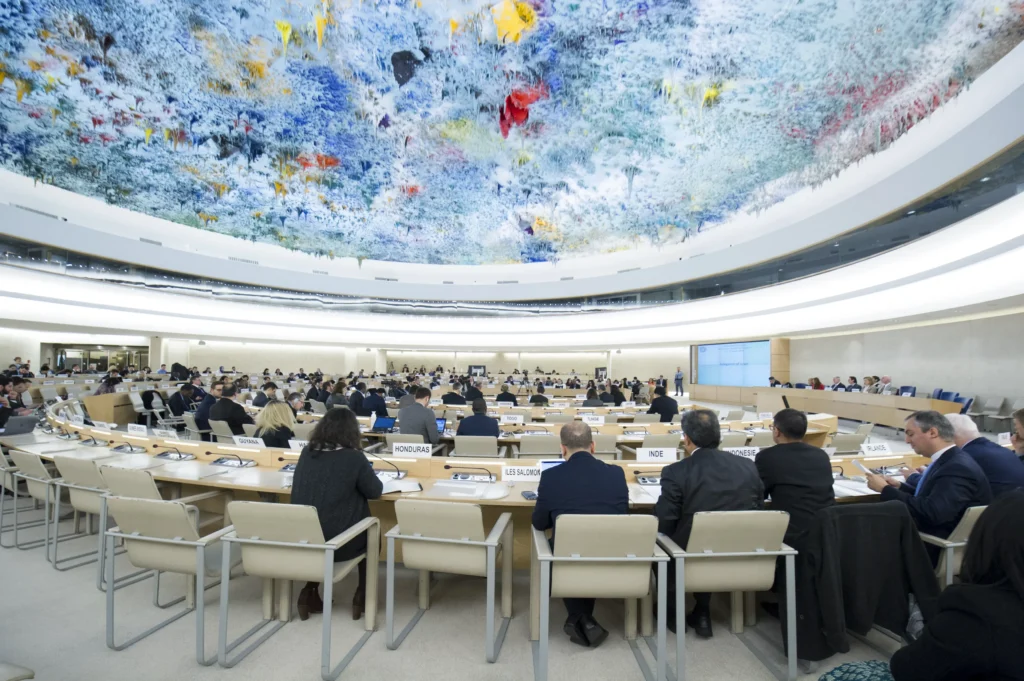
The UN Human Rights Council (UNHRC) reviews every member state’s overall human rights record through the UPR process, in which other member states make recommendations that the government accepts – in full or in part – or “notes”.
Malaysia has undergone four review cycles since 2009 and accepted over 500 recommendations.
February 2009
of 103 recommendations
October 2013
of 232 recommendations
November 2018
of 268 recommendations
January 2024
of 348 recommendations
Other commitments
Malaysia has been elected as a member of UNHRC three times serving the 2006–2009, 2010–2013, and 2022–2024 terms. During these terms, it has indicated firm commitments to human rights issues at the international level by co-sponsoring the following UNHRC resolutions:
- Safety of the child in the digital environment (A/HRC/RES/56/6);
- Promoting Human Rights and Sustainable Development Goals through Transparent, Accountable and Efficient Public Services Delivery (A/HRC/RES/52/8);
- The human right to a clean, healthy and sustainable environment (A/HRC/RES/48/13);
- Ensuring respect for international human rights law and international humanitarian law in the Occupied Palestinian Territory, including East Jerusalem, and in Israel (A/HRC/RES/S-30/1); and
- The safety of journalists (A/HRC/RES/39/6).
Global ranking: Where Malaysia stands?
Malaysia consistently sits in the middle of international rankings measuring key indicators for human rights and democracy.
Yale University · July 2026
23 places (2026)
(2024)
EIU · April 2026
2 places (2025)
(2024)
RSF · April 30, 2026
7 places (2026)
(2025)
Freedom House · March 19, 2026
(2026)
(2025)
Transparency International · February 10, 2026
3 places (2025)
(2024)
Freedom House · November 13, 2025
(2025)
(2024)
Legal framework
The Federal Constitution provides for:
- Right to life and personal liberty (in article 5);
- Prohibition of slavery and forced labour (article 6);
- Protection against retrospective criminal laws and double jeopardy (article 7);
- Right to equality on the basis of religion, race, descent, place of birth, and gender (article 8);
- Prohibition of banishment and right to freedom of movement (article 9);
- Right to freedom of speech and expression [article 10(1)(a)];
- Right to freedom of peaceful assembly [article 10(1)(b)];
- Right to freedom of association [article 10(1)(c)];
- Right to freedom of religion (article 11);
- Right to non-discrimination in education (article 12);
- Right to property (article 13); and
- Right to vote (article 119).
Articles 9, 10, 12, and 119 are guaranteed to citizens only whilst the rest extend to all persons. In practice, the following laws are often cited as restricting the constitutionally-guaranteed fundamental liberties:
- Personal liberty (particularly laws permitting detention without trial):
- Security Offences (Special Measures) Act 2012 (SOSMA),
- Prevention of Crime Act 1959 (POCA),
- Prevention of Terrorism Act 2015 (POTA),
- Dangerous Drugs (Special Preventive Measures) Act 1985;
- Speech and expression:
- Sedition Act 1948,
- Communications and Multimedia Act 1998 (CMA, particularly Section 233, broadened in 2024 amendment),
- Printing Presses and Publications Act 1984 (PPPA),
- Official Secrets Act 1972 (OSA),
- Penal Code provisions on criminal defamation (Sections 499–500) and “activities detrimental to parliamentary democracy” (Sections 124B),
- Online Safety Act 2024 (OnSA);
- Peaceful assembly: Peaceful Assembly Act 2012 (PAA);
- Association:
- Societies Act 1966, and
- Universities and University Colleges Act 1971 (AUKU/UUCA).
The right to privacy does not have express guarantee in the Federal Constitution but it is read into article 5 (right to life and personal liberty) per case law. The Personal Data Protection Act 2010 (PDPA) is limited to commercial transactions and do not apply to the government. Malaysia does not have national freedom of information (FOI) law. Only two states have implemented FOI – Penang and Selangor – and this right is not expressly guaranteed in the Federal Constitution but implied in article 10(1)(a) (see Sivarasa Rasiah v Badan Peguam Malaysia & Anor).
Recent developments
- Online Narratives and Digital Threats: The Spread of Misinformation, Disinformation, and Hate Speech Against Rohingya Refugees in Malaysia (cijmalaysia.net)
May 24, 2026 · Centre for Independent Journalism - Committee on the Rights of the Child: Concluding observations on the combined second to fourth periodic reports of Malaysia (CRC/C/MYS/CO/2-4)
February 5, 2026 · Committee on the Rights of the Child - Consideration of reports of States Parties – Replies of Malaysia to the list of issues in relation to its combined second to fourth periodic reports (CRC/C/MYS/RQ/2-4)
February 5, 2026 · Committee on the Rights of the Child - The State of Freedom of Expression in Malaysia 2025 (cijmalaysia.net)
December 9, 2025 · Centre for Independent Journalism - Malaysia Human Rights Report 2025 (suaram.net)
December 5, 2025 · SUARAM - Visit to Malaysia – Report of the Independent Expert on the enjoyment of all human rights by older persons, Claudia Mahler (A/HRC/60/24/Add.1)
July 4, 2025 · Human Rights Council - Malaysian Media Landscape: A Snapshot of 2024 (cijmalaysia.net)
May 16, 2025 · Centre for Independent Journalism
Compiled by Khairil Zhafri
Bulletin
Subscribe to our email newsletter to receive the latest news and updates from the MCCHR team directly in your inbox.
for Constitutionalism
and Human Rights